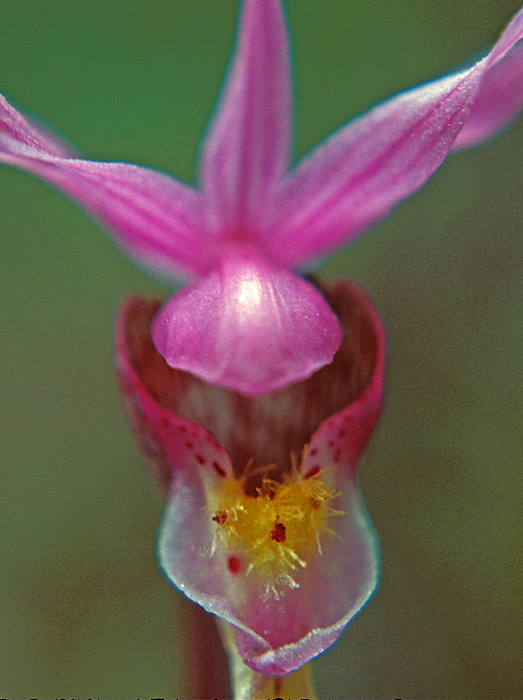
If you had a silver sword and a fairy slipper, what would you do with them? They sound like magical objects in a fairy tale. But you could plant them in your garden . . . because they are both flowers.
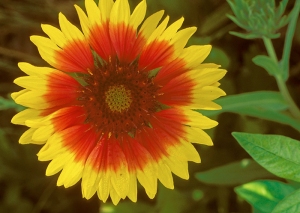
Firewheel, Gaillardia pulchella
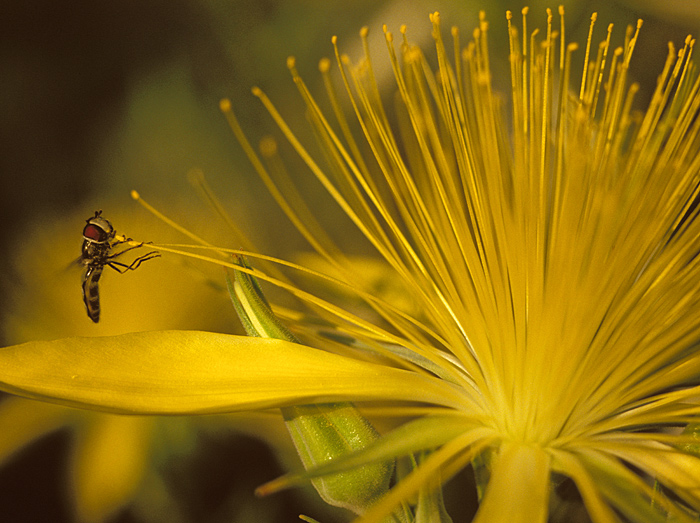
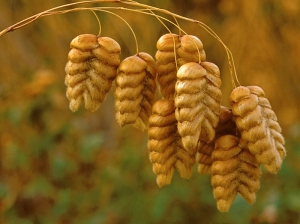
Six of these “look-alike” plants are pictured below. After studying their shapes and colors, try to guess their names. Then click on the photos for the answers–and for information about these interesting plants.
NAMES
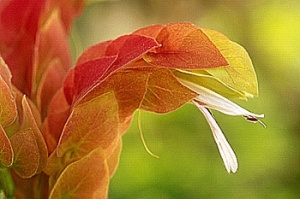
Shrimp PlantRattlesnake Grass
Silver SwordBleeding Heart
PaintbrushFairy Slipper
Here are two other fun activities:
1. Chose one or two of the plants above and write a fairy tale about magical “look-alikes.”
2. Make up your own “look-alike” flower. Draw it and name it. Then tell where it lives and give three interesting facts about it.
To see more exquisite flowers you can visit my husband’s and my photography website at: http://www.agpix.com/cohen
After a recent author program, the third grade teacher invited me to his classroom to read some of the writing his children were doing. That is when I discovered Adjective in Detail Poems. The formula is simple.
First pick your adjective and then write:
1) What your adjective is NOT
2) Three examples that show what your adjective is
3) Two examples of what your adjective sounds like
4) Another word for your adjective
5) One thing about your adjective
Here’s the poem I wrote.
GRACEFUL
Graceful is not a clackety-clanking crash.
Graceful is a silky-swirling scarf.
Graceful is a dainty-tiptoeing dancer.
Graceful is a sparkly-spinning skater.
Graceful sounds like smooth-soothing music.
Graceful sounds like the whisper of floating snow. Another word for graceful is elegant. One thing about graceful is it makes your heart sing.
Now try your own!
You can view or download my school program brochure:
Beneath the Atlantic Ocean, a humpback whale streaks skyward. It bursts into the air and then vanishes beneath the waves with a sparkling splash. Although whales are mammals, and not fish, they are comfortably at home in the water. But scientists have discovered something surprising about these water lovers . . . Their ancient ancestors lived on land. Here’s what the whales’ earliest known relative looked like:
Pakicetus attocki
By studying fossils and DNA evidence, scientists have learned much about the whales’ journey from land to sea.
They have also figured who the whales’ closest living relative is.
To get the fascinating facts, I interviewed John Flynn, of the American Museum of Natural History. Flynn is co-curator of the exhibition, “Whales: Giants of the Deep.” The exhibition leads visitors on adventures with models of these mighty creatures. Visitors can take a virtual dive with a sperm whale as it hunts for giant squid. Or they can crawl through a car-size replica of a blue whale’s heart. To learn more:
Using classroom science magazines is an effective and stimulating way to support the Common Core’s Reading Informational Text standards. It is also a way to help you meet the key anchor standards in Reading, Writing, Speaking & Listening, and Language. And of course, your children will be learning about science and current events.
Here is a link to a story I wrote for Scholastic about the Picturing Science exhibition at the American Museum of Natural History. The Art of Science
After your students have read the story, they can investigate the activities I have developed relating to Vocabulary Acquisition and Use, one of the Anchor Standards for Reading. I have also included an Art as Science activity.
Madagascan Cichlid
Part One:
Determine or clarify the meaning of unknown and multiple-meaning words and phrases by using context clues
Vocabulary word: DISSECT
The story explains, that instead of dissecting the fish to examine the tiny bones in their ears, Sparks uses a different technique. This technique allows him to keep all the parts that make up a fish’s ears intact. (together)
Since keeping all the parts that make up a fish’s ears intact is different from dissecting, what do you think dissecting means?
Look up the definition of dissecting. Write the meaning that best fits the word as it is used in sentence above.
Write three synonyms for dissect.
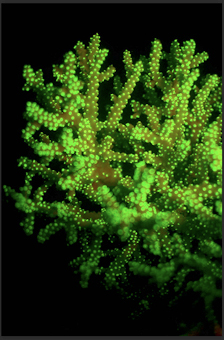
Glowing Coral
Vocabulary word: EMIT
The section on the Radiant Reef explains that fluorescentreef animals absorb blue light and emit green or red light. Another sentence says that these neon green and red creatures glow like aliens.
Since the fluorescent animals are glowing red and green, what do you think emit means?
Look up the definition of emit. Write the meaning that best fits the word as it is used in sentence above.
Write three synonyms for emit.
Part Two:
Vocabulary and Alliteration
Ladybird Beetles or Ladybugs
Alliteration is the use of similar sounds at the beginning of words. For example, Cichlids are a family of fish.
To make your own phrases using alliteration, look up synonyms for the word group. Choose three synonyms and write a phrase about a group of animals for each one. Here’s an example: a bunch of bugs
You can also add an adjective: a bunch of bustling bugs
Try another one.
In the story, I described the fluorescent reef animals as a dazzling display.
Look up synonyms for the word dazzling. Choose three synonyms and write a phrase using alliteration for each one. Here’s an example: shining ship
Juan Sebastian de Elcano Sailing Vessel at Night, Spanish Naval
Part Three:
Art as Science
Find something from nature that has a pattern, such as a seashell, a turtle shell, a rock, an insect wing. Using a magnifying glass or a microscope, observe the pattern up close. Now fold a piece of paper in half. On one side draw a close-up picture of the pattern. On the other side draw the whole object. (Instead of making drawings, you can also take photos.) Post your close-up picture on a bulletin board with a piece of paper below for other students to write their guesses about what they think the object is. When everyone has made their guesses, open up up the paper and re-post it so your classmates can see if they’ve guessed correctly.
Get in the mood for Halloween with scorpion heads, rodent teeth, and spider claws. Fantastic photos of these objects are part of the art show at New York’s American Museum of Natural History. The exhibition’s “artists” are the museum’s scientists. Their “artwork”—scientific pictures created with advanced imaging techniques. The exhibit features the work of:
John Sparks, who hunts for Madagascan cichlids in rivers crawling with crocodiles to study the fish’s hearing structures;
Madagascan Cichlid
David Gruber, whose photos of neon green and red fluorescent reef creatures glow like aliens;
Glowing Coral
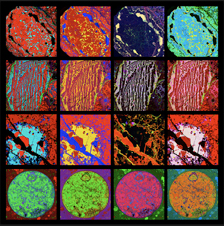
Ebel Denton, who blasts meteorites with electrons.Dentonis curious about the composition of these space rocks, which were wandering through our solar system for billions of years before crashing to Earth;
Meteorte Slices
Read the story I wrote for Scholastic about the exhibition at: Art as Science








 Judith Jango-Cohen
